
Physics of Joy · Positive Psychology Bridge
Vivation & Broaden-and-Build Theory
How Positive Emotions Expand Human Capacity — and How Vivation Trains That Expansion Through Direct Feeling
By Paul Hughes
Barbara Fredrickson’s broaden-and-build theory of positive emotions offers one of the clearest modern psychological explanations for something Vivation has always emphasized: enjoyment is not a luxury. It is a capacity-building force.
In everyday life, difficult emotions often narrow us. When we feel afraid, ashamed, angry, stressed, or emotionally overwhelmed, our attention tends to contract. The body tightens. The breath becomes smaller. The mind begins circling around fewer and fewer options: escape, defend, control, explain, blame, collapse, or hide. The world still contains many possibilities, but in that state we cannot see them. Our inner field has become small.
This narrowing has a biological purpose. Fear narrows attention toward danger. Anger prepares us to confront or protect. Disgust moves us away from what may be harmful. Shame can push us to hide, submit, or repair social bonds. These states are not wrong. They are part of the organism’s survival intelligence. In immediate danger, narrowed attention can save a life.
Contraction makes life smaller. Enjoyment makes life bigger. Repeated enjoyment builds a more capable human being.
Part One
The Psychology of Broadening
But survival narrowing is not the whole of human potential. If narrowing were the only function of emotion, life would become an endless management of threat. Human beings are not built only to survive. We are built to learn, connect, explore, create, play, love, savor, and expand. This is where Fredrickson’s broaden-and-build theory becomes so useful.
The theory proposes that positive emotions do something fundamentally different from threat-based emotions. Joy, interest, gratitude, serenity, hope, amusement, inspiration, awe, and love tend to broaden our momentary awareness. They open perception. They widen the field of possible action. They make us more curious, more creative, more flexible, more socially available, and more able to discover solutions that were invisible from contraction.
Over time, these broadened states help build lasting personal resources. Joy can build playfulness and creativity. Interest can build knowledge and skill. Gratitude can build meaning and connection. Love can build trust and social bonds. Awe can build humility and a sense of belonging to something larger. The positive emotion may be temporary, but what it builds can last.
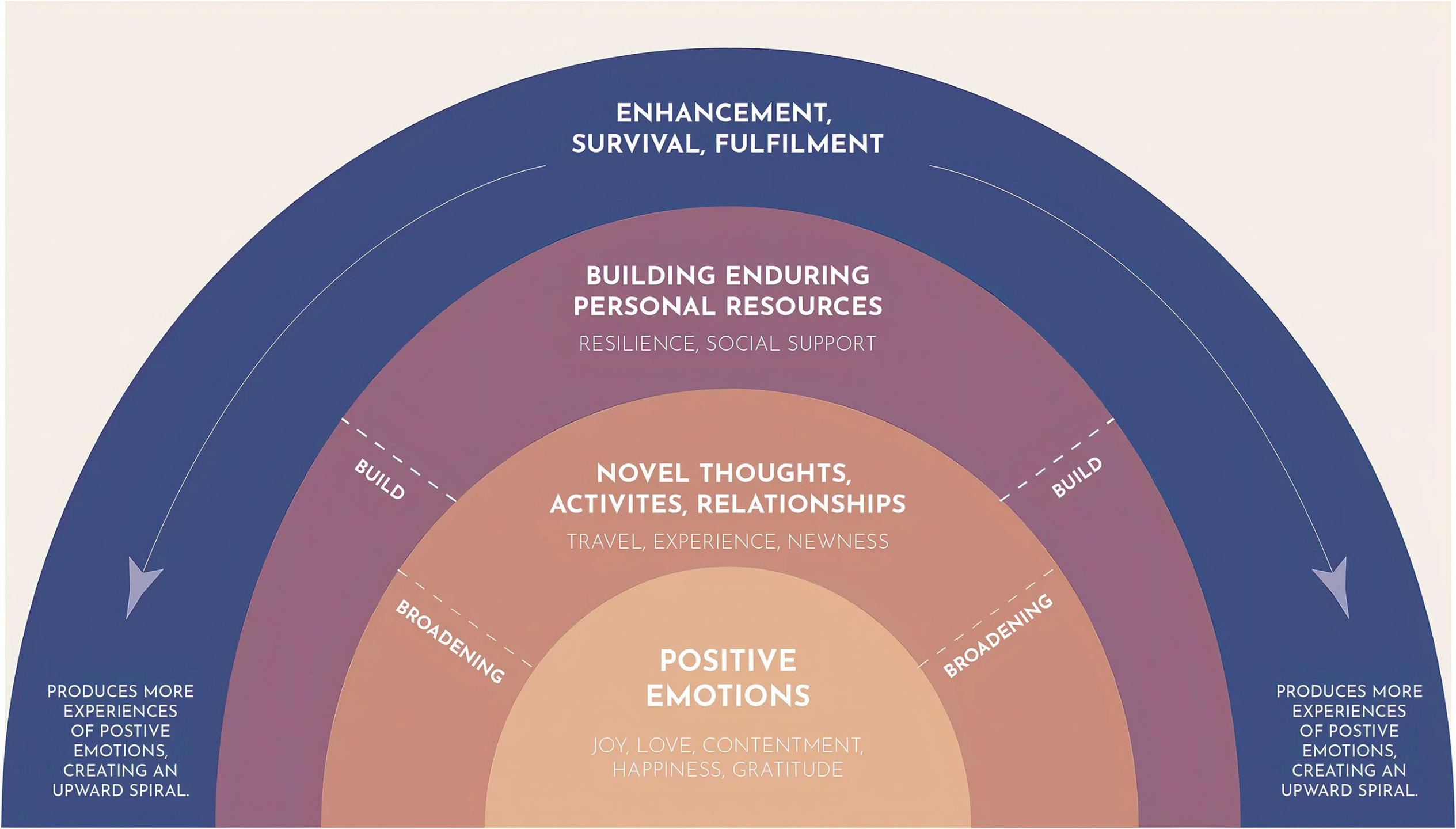
From the Vivation perspective, broaden-and-build is not merely a theory about positive moods. It is a psychological window into something deeper: the Physics of Joy.
For the full foundation of this framework, read Vivation & The Physics of Joy.
Part Two
The Physics of Joy
The Physics of Joy says that emotional energy is not inherently negative. What we call a “negative emotion” is often life-energy being experienced through resistance. The feeling itself appears to be the problem, but the deeper problem is the resistance around the feeling.
The Two Mechanics of Resistance
1. Constriction
Resistance constricts the flow of feeling, which makes the feeling seem stuck.
2. Compression
Resistance compresses felt experience into density, which makes the feeling seem solid, heavy, or overwhelming.
From stuckness and solidity, the mind then draws a meaning-conclusion: “This is bad by nature.” In Vivation, that conclusion is not the truth of the feeling. It is a perceptual distortion created by resistance.
When resistance softens, the same energy begins to reveal different qualities. What seemed like a block may become movement. What seemed like heaviness may reveal texture. What seemed solid may become spacious. What seemed threatening may begin to feel warm, alive, intelligent, or even pleasurable. The energy did not need to be destroyed. It needed to be received differently.
This is where broaden-and-build and Vivation meet.
When resistance contracts experience, the person narrows. When receptivity opens experience, the person broadens. When enjoyment becomes available, new capacity is built. Broaden-and-build describes the psychological result. The Physics of Joy explains the deeper mechanism. Vivation teaches the embodied skill.
Part Three
Broadening at the Level of Direct Feeling
A person who resists a feeling often experiences that feeling as heavy, dense, threatening, and permanent. The mind starts treating the feeling as a problem to solve or an enemy to escape. This is the narrowing effect of resistance. The feeling seems to take over the whole world. A tightness in the chest becomes “something is wrong with me.” A wave of sadness becomes “this will never end.” A surge of fear becomes “I can’t handle this.” The field of experience shrinks around the feeling, and the feeling appears more powerful than it actually is.
But when that same feeling is met with receptivity, the field begins to open. The person notices more detail. The sensation is no longer a single solid thing. It becomes warmth, pressure, pulsing, tingling, movement, vibration, texture, wave, space, ache, current, or aliveness. The body reveals that the feeling is not static. It is already changing. The mind stops fighting long enough for the body to show the truth of the experience.
That is broadening at the level of direct feeling.
This is why Awareness in Detail is so central to Vivation. The more detail we perceive, the less trapped we feel. A feeling stops being “that bad thing” and becomes a living pattern of energy. The body shows us that what seemed stuck is moving. What seemed solid is permeable. What seemed purely negative may contain warmth, aliveness, tenderness, strength, or subtle pleasure when met without resistance.
This does not mean we pretend every feeling is pleasant. It means we become honest enough, detailed enough, and receptive enough to discover what is actually happening beneath the mind’s first label. The thought “this is bad” is often much cruder than the feeling itself. The body is more nuanced than the story. The feeling is never as bad as our worst thought about it.
This is one of the great practical insights of Vivation. We do not integrate feelings by forcing ourselves to think positively about them. We integrate by feeling them so directly that the perceptual distortion of their negativity begins to dissolve.
This is not positive thinking.
It is positive perception at the level of direct feeling.
Part Four
Positive Perception, Not Positive Thinking
In ordinary positive psychology, a person might cultivate gratitude by remembering something good. They might cultivate joy by doing something playful. They might cultivate love by reflecting on someone dear to them. These are useful practices. They can broaden awareness and build real resources.
Vivation goes one step deeper. Vivation asks: can we find the positive current inside the feeling that is already here? Can we discover receptivity, aliveness, curiosity, and enjoyment even inside the place we were resisting? Can the very feeling that seemed to limit happiness become the doorway into happiness?
Positive thinking usually tries to change the story. Vivation changes the relationship to the felt experience underneath the story. The person does not need to convince themselves, “I am happy,” while they are clearly not happy. They simply need to feel what is actually present with enough relaxation, honesty, and receptivity that the feeling begins to reveal its deeper nature.
The Inner Sequence
Story → Sensation → Energy → Change → Spaciousness ↔ Bliss → Spacious Knowing
The mind begins with a story. The body reveals sensation. Sensation is recognized as energy. Energy reveals change. Change opens into spaciousness and bliss. And at the deepest level, the whole experience is known inside spacious awareness.
Part Five
Anxiety, Sadness, and the Body’s Hidden Intelligence
A simple example makes this clear.
Imagine a person feels anxiety in the chest. At first, the sensation seems tight, unpleasant, and threatening. Their mind calls it anxiety, then starts adding predictions: “Something is wrong. I can’t handle this. This needs to go away.” The more they resist, the smaller their world becomes. Their breath tightens. Their posture contracts. Their attention locks onto the discomfort. The anxiety seems solid.
In Vivation, the person does not try to get rid of the anxiety. They begin by noticing where the strongest feeling is in the body. They breathe gently and consciously. They relax the exhale. They notice subtle changes. They inhale through the strongest feeling, as though the breath can move directly through the sensation. They become curious about the exact texture of the experience.
Very often, what seemed like a solid block begins to change. The tightness becomes vibration. The pressure becomes movement. The anxiety becomes energy. With more receptivity, the same energy may begin to feel like alertness, excitement, readiness, or life-force. The body begins to experience what the mind had called “anxiety” as something less fixed and more alive.
This is the Physics of Joy in practice. The feeling was not inherently bad. It was being experienced through resistance. As resistance dissolves, the field of experience broadens, and the same energy is recognized as more open, dynamic, and alive. As the field broadens, capacity grows.
This is also broaden-and-build inside the body.
The same principle can be seen with sadness. When resisted, sadness can feel heavy, collapsed, and painful. The mind may call it weakness, loss, or failure. The body may contract around it. But when sadness is felt directly, without making it wrong, it often reveals tenderness. With more receptivity, tenderness may reveal love. With still more receptivity, sadness may reveal gratitude: gratitude for what mattered, gratitude for what was loved, gratitude for the heart’s capacity to care.
The content of the feeling may not vanish instantly. The intensity may remain. But the relationship changes. The experience becomes more spacious, more intimate, more meaningful, and less opposed. That shift of relationship is the beginning of integration.
Part Six
Vivation as Capacity Training
Fredrickson’s theory helps us understand why this matters. Positive emotions are not merely pleasant decorations added to life after the real work is done. They are functional. They expand the organism’s field of possibility. They make learning, bonding, creativity, recovery, and resilience more available.
Vivation agrees, but takes the insight into the subtle mechanics of feeling. When a person learns to enjoy a feeling they used to resist, they are not merely “feeling better.” They are building capacity. They are building the capacity to stay present. They are building the capacity to relax under activation. They are building the capacity to feel without collapsing. They are building the capacity to choose their relationship to experience. They are building emotional sovereignty.
This is why Vivation is not merely a state change. It is a skill.
A state change is temporary. A person feels bad, does a technique, and feels better for a while. There is nothing wrong with that, but it does not necessarily create autonomy. The person may remain dependent on the technique, the teacher, the setting, the music, the ritual, or the session. Vivation aims for something more powerful: the ability to meet experience directly, in ordinary life, and integrate it through one’s own embodied skill.
This is where broaden-and-build becomes especially important. If positive emotions broaden awareness and build resources, then the ability to find genuine enjoyment inside direct feeling becomes a profound form of human training. It means we are not only creating pleasant moments. We are building a nervous system, a mind, and a life that can hold more.
The capacity to enjoy is the capacity to broaden.
The capacity to broaden is the capacity to build.
Part Seven
The Difference That Makes Vivation Unique
There is, however, one crucial difference between ordinary broaden-and-build theory and Vivation. Broaden-and-build usually begins with emotions that are already recognizably positive: joy, interest, gratitude, love, awe, contentment. Vivation often begins with whatever feeling is actually strongest, even if the mind initially labels that feeling unpleasant.
That is the power of the method.
Vivation does not say, “Ignore the difficult feeling and think about something positive.” It says: feel what is actually here. Notice the subtle changes. Inhale through the strongest feeling. Enjoy this moment as much as you can.
This means the practice does not depend on favorable circumstances. It does not require life to present an obviously beautiful moment before broadening can begin. The strongest feeling itself becomes the doorway. The very place where life had narrowed becomes the place where life can broaden.
This is a much deeper and more resilient form of positivity.
It is easy to feel open when everything is going well. It is easy to feel grateful when we have just received what we wanted. It is easy to feel loving when we are being loved in the way we prefer. The real training begins when the feeling is not immediately welcome. Can we remain receptive there? Can we soften there? Can we discover movement there? Can we find even one percent of genuine enjoyment there?
A Crucial Safety Note
This must always be done with kindness, choice, and respect for capacity. Vivation does not ask anyone to force intensity, override themselves, or pretend that overwhelm is spiritual progress. If a feeling becomes too intense, the instruction is not “push harder.” The instruction is to reduce intensity, relax the exhale, widen attention, and return to what can honestly be felt now. Enjoyment only matters when it is real. Even one percent is enough.
Vivation does not demand that we enjoy more than we can. That would become another form of pressure. The instruction is beautifully precise: enjoy this moment as much as you can. Not as much as you should. Not as much as someone else can. Not as much as an idealized spiritual version of yourself would enjoy it. As much as you can, honestly, now.
That small honest opening is enough.
Part Eight
Enjoyment as Vector, Integration as Flip
A tiny thread of enjoyment changes the whole context of experience. It gives the body permission to stop bracing. It gives attention a reason to stay. It gives the feeling enough welcome to begin revealing itself. From there, the field broadens. As the field broadens, the person discovers more capacity than they had while resisting.
This is why enjoyment is not superficial in Vivation. Enjoyment is the orienting vector. It points the whole system toward integration. It does not force the result; it shows the direction. Integration happens when the resistance collapses and the inherent okayness, pleasantness, or goodness of the experience becomes obvious.
Enjoyment is the vector.
Integration is the flip.
Enjoyment points the system toward receptivity. Integration is the moment resistance collapses and the inherent goodness or bliss of the feeling becomes obvious.
In this way, Vivation creates a somatic upward spiral.
First, a feeling becomes activated. The person notices that something in experience is not okay with them. Instead of suppressing the feeling, they relax and feel it. They notice subtle changes. The feeling becomes less solid. They inhale through the strongest feeling. They find a more receptive, enjoyable relationship to it. The feeling integrates. They trust themselves more. The next time a similar feeling arises, they are less afraid of it. Their life gets bigger.
This is how a single moment of practice becomes a long-term resource.
Each integration teaches the body that feelings are safe to feel. Each integration reduces the fear of future activation. Each integration increases confidence in one’s own capacity. Each integration builds the expectation that even difficult feelings may contain hidden energy, meaning, pleasure, gratitude, or freedom.
This is not merely emotional relief. It is emotional education. The person is learning, at the level of direct experience, that life is more workable, more fluid, and more benevolent than resistance made it appear.
Part Nine
The Inner Skill of Happiness
The broaden-and-build theory helps explain why this creates lasting change. When a person broadens repeatedly, they build resources repeatedly. They become more flexible because they have practiced flexibility. They become more courageous because they have practiced staying present. They become more emotionally intelligent because they have practiced feeling in detail. They become more connected because they are no longer at war with so much of their own experience.
Over time, this changes identity. The person no longer thinks, “I am someone who cannot handle my feelings.” They begin to know, directly, “I can feel what arises. I can breathe with it. I can relax around it. I can discover the good within it. I can integrate.”
That is a different human being.
A person who can only broaden when life is easy has a fragile form of happiness. Their happiness depends on conditions. They need the right environment, the right people, the right mood, the right outcome, the right amount of approval, comfort, certainty, or control.
A person who can broaden inside fear, sadness, anger, boredom, shame, uncertainty, intensity, or disappointment is developing a deeper form of happiness. They are no longer dependent on perfect conditions. They are learning to find openness inside conditions as they are. They are building the inner skill of happiness.
This does not mean they become passive. It does not mean they stop changing their life, protecting boundaries, pursuing goals, or acting wisely. In fact, the opposite is often true. When a person is less contracted, they can act more clearly. They have more options. They can respond instead of react. They can pursue purposeful desires without making their happiness conditional on the outcome.
This is another way broaden-and-build supports the Vivation paradigm. Positive emotion does not remove action. It improves the quality of action. It broadens the field so more intelligent action becomes possible.
From contraction, the mind often asks, “How do I make this stop?” From receptivity, the deeper intelligence of the body can ask, “What is this feeling? How is it changing? What is it showing me? How can I receive it? What becomes possible when I stop fighting it?”
Those are broader questions. They build a broader life.
Part Ten
The Practical Implications
The practical implications are enormous. If enjoyment builds capacity, then learning to enjoy more of present-moment experience is not indulgence. It is training. If receptivity broadens perception, then relaxing resistance is not weakness. It is intelligence. If feelings integrate when they are welcomed into wholeness, then emotional sovereignty is not achieved by control. It is achieved by direct, skillful intimacy with life as it is.
This is the heart of Vivation.
Broaden-and-build tells us that positive emotions expand human capacity. The Physics of Joy tells us that this expansion happens because resistance is dissolving and the inherent positivity of experience is becoming available again. Vivation gives us the practical method: breathe, relax, feel in detail, receive the strongest feeling, and enjoy this moment as much as we can.
As resistance dissolves, life broadens. As life broadens, the human being builds. And as this becomes a repeatable skill, happiness is no longer merely something that happens to us.
It becomes something we can practice.
Source Note
This article draws on Barbara Fredrickson’s broaden-and-build theory of positive emotions, especially her formulation that positive emotions broaden momentary awareness and help build durable personal resources over time.